

SCOOP: Florida Republican Rep. Scott Franklin Violated the Law By Failing to Disclose 31 Stock Trades on Time
The former insurance executive is the latest member of Congress to violate the STOCK Act requiring timely disclosure of stock transactions
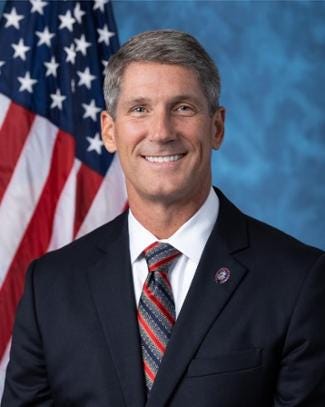
Rep. Scott Franklin (R-Fla.) is the latest member of Congress to violate a federal law designed to curb conflicts of interest, stop insider trading and enhance public transparency, a Hunter Index review of congressional financial records indicates.
Franklin failed to disclose — until last week — 31 stock trades made between January 2024 and September 2024 for himself and his wife. The federal Stop Trading on Congressional Knowledge (STOCK) Act mandates that lawmakers disclose such trades no later than 45 days after they’re made.
Franklin’s late disclosures include shares of a variety of blue-chip stocks, including several large government contractors such as General Dynamics, Microsoft and Lockheed Martin, according to congressional records. Others include Google parent Alphabet, Apple, Berkshire Hathaway, Comcast, Home Depot, Johnson & Johnson, McDonald’s, Starbucks, United Parcel Service and Walmart.
In all, Franklin’s trades — mostly stock purchases — are valued at between $35k and $525k. (Lawmakers are only required to disclose the value of their trades in broad ranges.)
In a memo to the Clerk of the House of Representatives, Franklin wrote that most of the stock trades were made by a stock broker for his wife’s Roth IRA account “in order to rebalance the portfolio in accordance with the firm’s investment strategy.” Franklin added that the broker “failed to notify me of these transactions and it wasn’t discovered until I was attempting to reconcile our investment holdings” ahead of filing an annual congressional disclosure report covering all of 2024.
“Apparently, there was some turnover this past year in the people who work on our accounts and someone didn’t get the word about the absolute necessity to advise me on every transaction as soon as possible,” Franklin wrote Monday in an email to the Hunter Index. “I’ve addressed the seriousness of this with my broker and advised that I will terminate our business relationship if it ever happens again.”
More than a dozen members of Congress have this year alone violated the STOCK Act’s disclosure provisions to one extent or another according to various media reports, including those from the Hunter Index. Dozens more have violated the STOCK Act this decade.
The standard fine for a first-time STOCK Act violator is $200, with fines increasing for subsequent violations.
But the House Committee on Ethics, which administers the STOCK Act for House members, does not publicly disclose how much it fines violators — if it fines them at all, given its leeway to waive fines at its discretion.
Franklin’s congressional office said Monday that it doesn’t yet know if Franklin will be required to pay a late penalty. Tom Rust, the chief counsel for the House Committee on Ethics, declined to comment.
This year, congressional Republicans and Democrats have introduced several similar bills that would ban or otherwise limit lawmakers and their immediate family members from trading individual stocks, and in some cases, cryptocurrency.
A congressional stock-trade ban received a significant boost in recent weeks as President Donald Trump, House Speaker Mike Johnson (R-La.) and House Minority Leader Hakeem Jeffries (D-N.Y.) have all endorsed the idea, in principle. But none of the bills have yet received a vote.
One government reform advocate says a ban can’t arrive too soon.
“It’s beyond frustrating that members of Congress continue to fall short of the disclosure requirements when they simply refuse to impose any commonsense anticorruption rule that bars stock trading,” said Walter Shaub, the former director of the U.S. Office of Government Ethics under presidents Barack Obama and Donald Trump. “This is just another reminder that we need the congressional stock ban.”
Franklin is serving his third congressional term, and his 18th congressional district includes a large swath of south central Florida immediately south of Orlando, east of Tampa and northwest of Miami.
He is one of Congress’ more wealthy members, with an estimated net worth of $23.4 million, according to a Hunter Index analysis.
Franklin’s explanation for his STOCK Act violation is atypically candid for a member of Congress, most of whom have declined to comment or issued terse statements through their congressional staff over the years. His email to the Hunter Index is printed here in its entirety, lightly edited for style:
In order to prepare my 2024 annual financial disclosure in May, I asked my broker to provide me with a list of my wife’s and my stock holdings on Dec. 21, 2024. By comparing year end 2024 holdings to the stocks held at year end 2023, any differences should have been captured in periodic transaction reports filed for transactions occurring during 2024.
In the course of preparing this information, my broker discovered they had made transactions during the year of which he failed to notify me. Specifically, these transactions included sales of four stocks on Jan. 30, 2024, in our joint account, the purchase of 29 stocks in my wife’s Roth IRA on Aug. 7, 2024, and the purchase of two stocks in her Roth IRA on Sept. 25, 2024. I didn’t file the PTR’s for these transactions as required by the Stock Act because I wasn’t aware they had occurred. I did file four other reports over the course of 2024 for other transactions when advised of the trades by my broker.
After my broker advised me of his discovery of the unreported transactions, I immediately notified House Ethics of the matter. Ethics advised that I request an extension to complete my 2024 Financial Disclosure in order to take the time to ensure we got it right. I did so and received an extension until Aug. 13, 2025.
Once my broker and I were sure of the missing transactions and that there were no others, I filed draft PTR’s and submitted them to House Ethics counsel for review and commentary. It was on counsel’s advice that I made the comments on the PTR public [document]. Those comments explain the nature of the transactions and why the report was being filed late
As I have shared when asked by reporters regarding all PTR’s I’ve filed since becoming a member of Congress, I have absolutely no idea what my broker decides to buy or sell, or when they choose to do it. The only way I even know to file a report is when they notify me of activity. Apparently, there was some turnover this past year in the people who work on our accounts and someone didn’t get the word about the absolute necessity to advise me on every transaction as soon as possible. I’ve addressed the seriousness of this with my broker and advised that I will terminate our business relationship if it ever happens again. I am fully aware that every transaction made on our accounts receives press attention and now, they do too.
The notion held by some in the public and fed by the press that members of Congress are getting wealthy off some sort of “insider information” is baseless. Insider trading is illegal, regardless of who does it. The only time I’m ever even aware of the stocks I own is when I review the end of year list or am notified of a transaction.
To avoid even the appearance of impropriety, I have an investment policy statement on file with my broker that provides overall strategy objectives and risk tolerance. Within the bounds of that policy, my broker is free to buy and sell any shares they deem to be in accordance with the stated goals. Typically, the portfolio decisions they make apply to all the accounts they manage that share the same characteristics as my wife’s and mine.
That was specifically the case with the 29 stock purchases in my wife’s Roth IRA on 8/10/24. Her account had grown to a threshold where our broker uses a different mix of stocks. These represented stocks across nearly every industry sector and happened to include shares in companies whose work includes the defense industry. Just as notable, the purchases included McDonalds, Hershey, Starbucks and Walmart. No one seems to be concerned about trades dealing with burgers, coffee, chocolate or retail goods. All 29 are blue chip stocks that are commonly held in a broad and balanced portfolio.
As to my position on members of Congress being allowed to own stocks, I’ll follow the will of the Congress, but personally think a total ban would be a mistake. At every turn, the sacrifices necessary to serve in Congress continue to mount, while the benefits continue to diminish.
As the owner of an insurance agency, I was required to sell my business in order to serve in Congress. Whenever I share that in talks with constituents, most are shocked to know that lawyers, accountants, insurance agents and financial advisors are all required to divest of any ownership interest in order to serve Congress. Ironically, it’s the proceeds from the sale of my business I’d worked so hard to grow that are now the subject of the stock issues we’re discussing.
Add to that the fact that Congress hasn’t received a single raise or cost of living increase in 16 years, we are required to purchase our health insurance from the federal exchange (Obamacare), and there’s no pension unless one serves at least three terms — and then it’s 1 percent of salary for each year served.
Don’t get me wrong — I understood the requirements when I decided to run for Congress and chose to do so, anyway. Many who run for office now have accumulated wealth prior to coming to Washington. I worry we’re on the path to a day when ONLY the wealthy can afford to run for federal office, and that would be a travesty.
In Franklin’s first report filed as a congressional candidate, he detailed the sale of the insurance agency where he served as an executive. Founded in 1941, Lanier Upshaw Inc. was acquired by BKS Partners, which is now known as The Baldwin Group, a publicly traded company listed on NASDAQ.
As part of the acquisition, Franklin received 312,231 shares of BKS Partners stock worth between $5 million and $25 million on his candidate form filed on July 14, 2020. The form was amended after he was sworn into Congress in January 2021.
According to his latest annual report, Franklin still owned Baldwin Group stock worth between $5 million and $25 million, which was the largest asset in his family’s portfolio. Franklin is slated to file an updated personal financial disclosure, covering his finances during 2024, in August.
On his candidate form, Franklin reported receiving over $1 million in income from his employer Lanier Upshaw for the 2019 calendar year. He received $632,898 in income and $470,853 in shareholder distribution income. In 2020, he reported earning $360k from BRP Colleagues, Inc., when he was also running for Congress.
Dave Levinthal is a Washington, D.C.-based investigative reporter.
Why Does It Matter?
Please be informed of your politicians’ personal finances.
That’s our mission at the Hunter Index. We believe it is important for constituents to understand how their government officials’ personal finances may affect their policy making decisions as well as understanding the potential wide disparity between their wealth and that of the people in their home state or district.
Remember our favorite questions: Would you make a decision that costs your family money for the public good? Isn’t that what we ask of our government officials?
Managing Hunter Index and its exclusive database which makes reporting like this article possible is extremely expensive and labor intensive.
Please consider becoming a paid subscriber to help fund this nonprofit news organization led by a disabled journalist or help grow our readership by sharing this publication with others.